Executive Summary
We take our inspiration from the National Development Plan, Vision 2030.
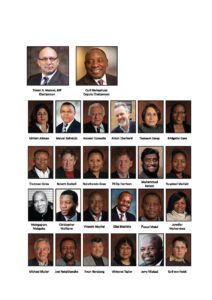
In May 2010, the then President of South Africa, Jacob Zuma, appointed the National Planning Commission, to draft a National Development Plan for South Africa. The advisory body consisted of 26 persons, drawn largely from outside government, chosen for their expertise in key areas.
The Commission consulted widely on the draft national plan, released in November 2011. The public forums drew in thousands of people, including Parliament, the Judiciary, National Departments, Development Finance Institutions, State Owned Enterprises, Local Government Formations, Trade Unions, Business, Religious Leaders, and Non-Profit Organisations.
The National Development Plan’s key objectives aimed to eliminate poverty and reduce inequality by 2030.
A major conclusion of the plan asserted that SA can realise these goals by drawing on the energies of the people, growing an inclusive economy, building capabilities, enhancing the capacity of the State and promoting leadership and partnerships throughout society.
Excerpt from the National Development Plan:
“The welfare of each one of us, is the welfare of all.
We refrain from being cruel, hurtful or demeaning in disagreement.
We celebrate the differences amongst us.
We solve our differences through discussion.
Our connectedness across time and distance is central to our humanity.
We are conscious of the intimate relationship between tradition and change.”
Our Approach
“What we do with our world, right now, will propagate down through the centuries and powerfully affect the destiny of our descendants. It is well within our power to destroy our civilisation, and perhaps our species as well. If we capitulate to superstition, greed or stupidity, we can plunge our world into a darkness deeper than can be imagined. But we are also capable of using our compassion and our intelligence, our technology and our wealth, to make an abundant and meaningful life for every inhabitant of our planet.
When we shy away from the challenges of our complex world, because it seems too difficult, we surrender our ability to take charge of our future. We are disenfranchised. Our self-confidence erodes.” – Carl Sagan.
“The dire and incalculable consequences of the insidious violence of corruption that has led to the deprivation of a chance of millions of South Africans to reclaim their human dignity is a gross violation of human rights.” – Pumla Gobodo-Madikizela.
There are a number of problems that we face that are inherently global and cannot be solved without international cooperation including – climate change, ocean degradation, pandemics, migration, cybercrime, nuclear proliferation and dark money.
The development state needs to be capable, but a capable state does not materialise by decree, nor can it be legislated into existence by declarations. It has been built, brick by brick, institution by institution, and sustained and rejuvenated over time. It requires leadership, sound policies, skilled managers and workers, clear lines of accountability, appropriate systems and consistent and fair applications of rules.
“Problems are inevitable because our knowledge will always be infinitely far from complete. Some problems are hard, but it is a mistake to confuse hard problems with problems unlikely to be solved. An optimistic civilisation is open and not afraid to innovate and is based on traditions of criticism. Its institutions keep on improving and the most important knowledge that they embody is the knowledge of how to detect and eliminate errors.” – David Deutsch.
Our Challenges
How do we engage all sectors of Society in our endeavour to grow the economy
How do we build trust in our institutions at Local, Provincial and National level.
What do we need to do to create the conditions and environment for higher levels of private and public investment.
Determine the factors that inhibit growth and those that promote growth.
What do we do to improve the quality of our Education?
Create a greater awareness that we, all of us, have agency, and that working together, we can build a flourishing economy in the Region.
Our Journey
Design and deliver a public education programme to address the various obstacles and opportunities to economic growth.
– Create a greater awareness of the impact of our individual and collective actions on the growth of our economy
– Create a greater awareness that we , all of us, have agency, and that working together we can build a flourishing economy in SA and the Region.
– Facilitate partnerships to give effect to the discussions, from the village to the broader Southern African Region.
– Collect and collate data essential in addressing the multitude of obstacles and opportunities.